How to Store Slime So It Stays Soft for Months
Handmade slime is mostly glue and water, so it lives or dies by how you put it away. Here's the exact routine we send with every PinkPopSlime order.
You bought (or mixed) the perfect slime, played with it for a week, and now it’s a stiff little rock or a sticky puddle glued to the lid. It’s one of the most common slime disappointments, and it almost always traces back to one thing: how you put the slime away. Knowing how to store slime is the whole difference between a jar that stays squishy for months and one that’s ruined by Friday. The best part is that keeping slime fresh takes about ten seconds a day and zero special equipment, just a clean container and a couple of habits.
Why does slime dry out and turn hard?
Slime dries out because it is mostly water, and open air slowly pulls that water back out. When PVA glue (the kind in Elmer’s) meets an activator like contact lens solution or borax, the activator cross-links the glue’s long polymer chains into a stretchy net, and water sits trapped inside that net. That trapped water is what gives slime its squish. Leave the jar open and the water evaporates into the room, the net tightens up, and the slime goes stiff and crumbly. Add skin oils, hand lotion and bits of dust on top of that, and the structure starts to break down faster still.
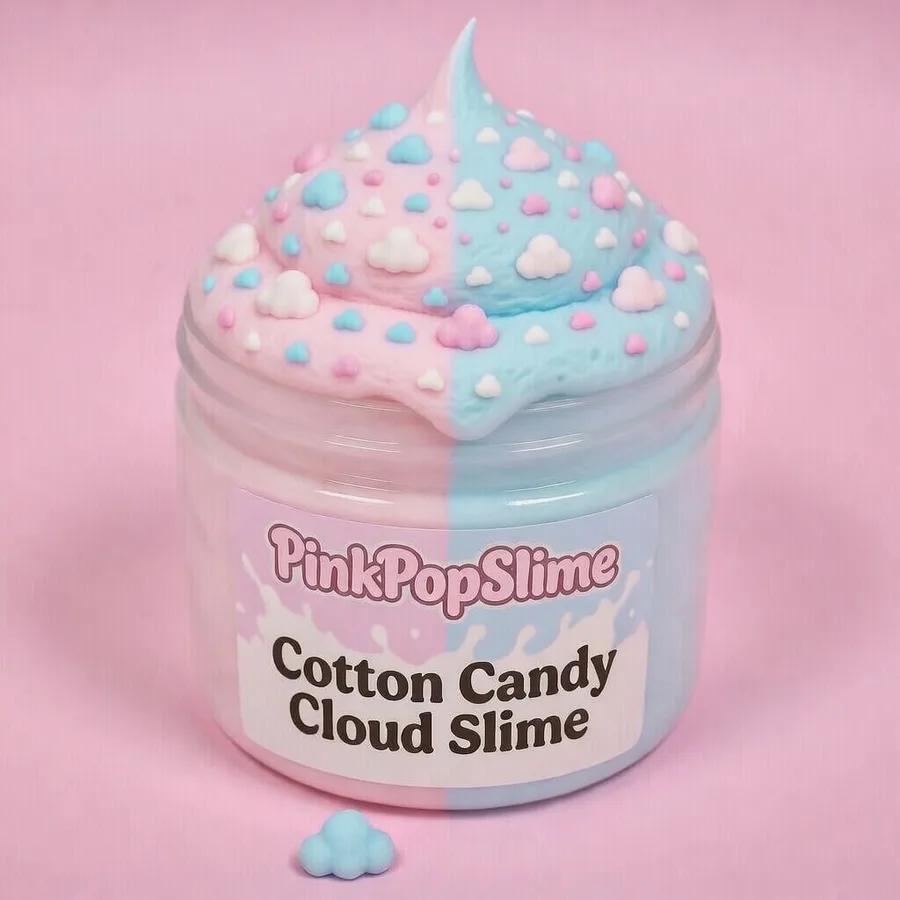
Here is the reassuring part: this is a slow, everyday process, not instant damage. A cared-for slime only needs a few seconds of attention each time you finish playing, and it will stay good for a couple of months. Airier textures like cloud slime and butter slime lose their fluff a little sooner because they hold more air, but that is normal rather than a defect, and a quick re-knead brings the softness right back.
How to store slime so it lasts for months?
The short answer: get every last bit of slime back into a clean, airtight container, press the air out, and keep it somewhere cool and shaded. That is the entire routine, and it is the exact one we tuck into every PinkPopSlime order. Do these five steps every single time and your slime will reward you.
- 1
Play on a clean surface
Wipe the table first. Crumbs, hair and dust are what turn smooth slime grainy, and once they are kneaded in they do not come back out.
- 2
Wash and dry your hands
Skin oils and hand lotion are slime's worst enemies. Clean, fully dry hands keep the texture stretchy instead of sticky.
- 3
Scoop every bit back in
Collect the slime off your hands and the table so no small pieces are left behind to dry out separately and go crusty.
- 4
Press the air out
Push the slime flat into its container before sealing. Less trapped air inside the jar means less moisture escaping over time.
- 5
Seal it airtight
Snap the lid fully shut, then store the jar somewhere cool and shaded. A drawer or a shelf away from the window is perfect.
Is an airtight container really necessary?
Yes, an airtight container is the single most important part of slime storage, full stop. This is the one habit that decides whether your slime survives. The clip-lid jar or squeeze tub your slime arrives in is airtight by design, so the easiest move is simply to keep using it. If you decant into something else, choose a container with a tight, fully sealing lid rather than a loose bowl with plastic wrap on top. Here is what actually happens to the same slime over the same days, sealed versus left out.
| Sealed airtight | Left out uncovered | |
|---|---|---|
| After 1 day | Perfectly soft | Tacky, dry skin forms |
| After 1 week | Still stretchy | Stiff with hard edges |
| After 1 month | Great after a quick refresh | Dried out and cracking |
Same slime, two very different weeks. The lid does almost all the work.
If you remember one thing from this whole article: seal the lid every single time.
Where’s the best place to keep slime?
Keep slime somewhere cool, dry and shaded, like a drawer, a cupboard or a shelf away from windows and heat. Temperature and light matter more than people expect. A jar left on a sunny windowsill or next to a radiator warms up, and heat speeds the slime toward either a melty, over-soft mess or a dried-out one, depending on the texture. A cold garage or a freezing car can do the opposite and make slime hard and unpleasant to knead until it warms again. Damp, humid spots like a steamy bathroom cabinet are worth avoiding too, since trapped moisture sitting on slime over weeks is what invites mold.
The fridge is a useful trick rather than a rule. Chilling a slime that has gone too soft or too warm will firm it up nicely, but let it come back to room temperature before you play so it returns to its normal stretch. For everyday storage, a shaded shelf at room temperature is all you need to keep slime fresh.
How long does slime last if you store it right?
Stored right, handmade slime stays good for roughly two to three months; stored badly, it can be ruined in a week. So the real answer comes down to your habits, not luck. Because slime is a water-based product with no strong preservatives, it will not last forever, and that is normal for anything handmade and squishable. What you are protecting against is early death from air exposure and dirt, and airtight storage with clean hands buys you nearly all of that time.
You will know a slime has genuinely reached the end when it smells off, grows any spots of mold, or refuses to soften no matter how much water you knead in. At that point it is time to retire it and treat yourself to a fresh batch rather than trying to revive it.
What if your slime already dried out or got sticky?
Most tired slime is fixable in under a minute: add warmth and water for stiffness, or a drop of activator for stickiness. If your slime has gone hard and stiff, knead in a few drops of warm water (or a little lotion for opaque and butter slimes) until the softness returns; our full walkthrough on how to bring stiff slime back to life covers every texture. If it has swung the other way and turned sticky, the fix is to gently de-stick a sticky slime with a tiny bit more activator. And if you want the whole picture in one place, our complete slime care guide collects every fix and habit together.
Slime emergency handled? Reward yourself and pop a few 👇
Popped: 0 🫧
Sometimes, though, a slime is simply past saving. It was left open too long, dried well beyond what a little water can undo, or reached the end of its natural life. When that happens, the kindest move is not to fight it but to start fresh with a new handmade batch, and a low-maintenance texture makes staying on top of storage effortless.
Quick questions
Where can I learn how to store slime step by step?
How long does slime last once it's opened?
What kind of container is best for slime storage?
Can I keep slime in the fridge?
Why did my slime get hard in storage?
Why is my slime sticky even though I stored it sealed?
Does cloud or butter slime need different storage?
Is it safe to keep playing with slime that feels a bit tacky?
That is really all it takes. Ten seconds of care and the right jar, and your slime stays soft, stretchy and ready to squish whenever you are.